
Is El Salvador Safe for Tourists Now? An Honest FAQ from the Surf City Coast
A practical FAQ on El Salvador safety in 2026 — night walks, taxis, beach theft, solo travel and the ocean risks that actually send people to hospital, answered from the Surf City coast.
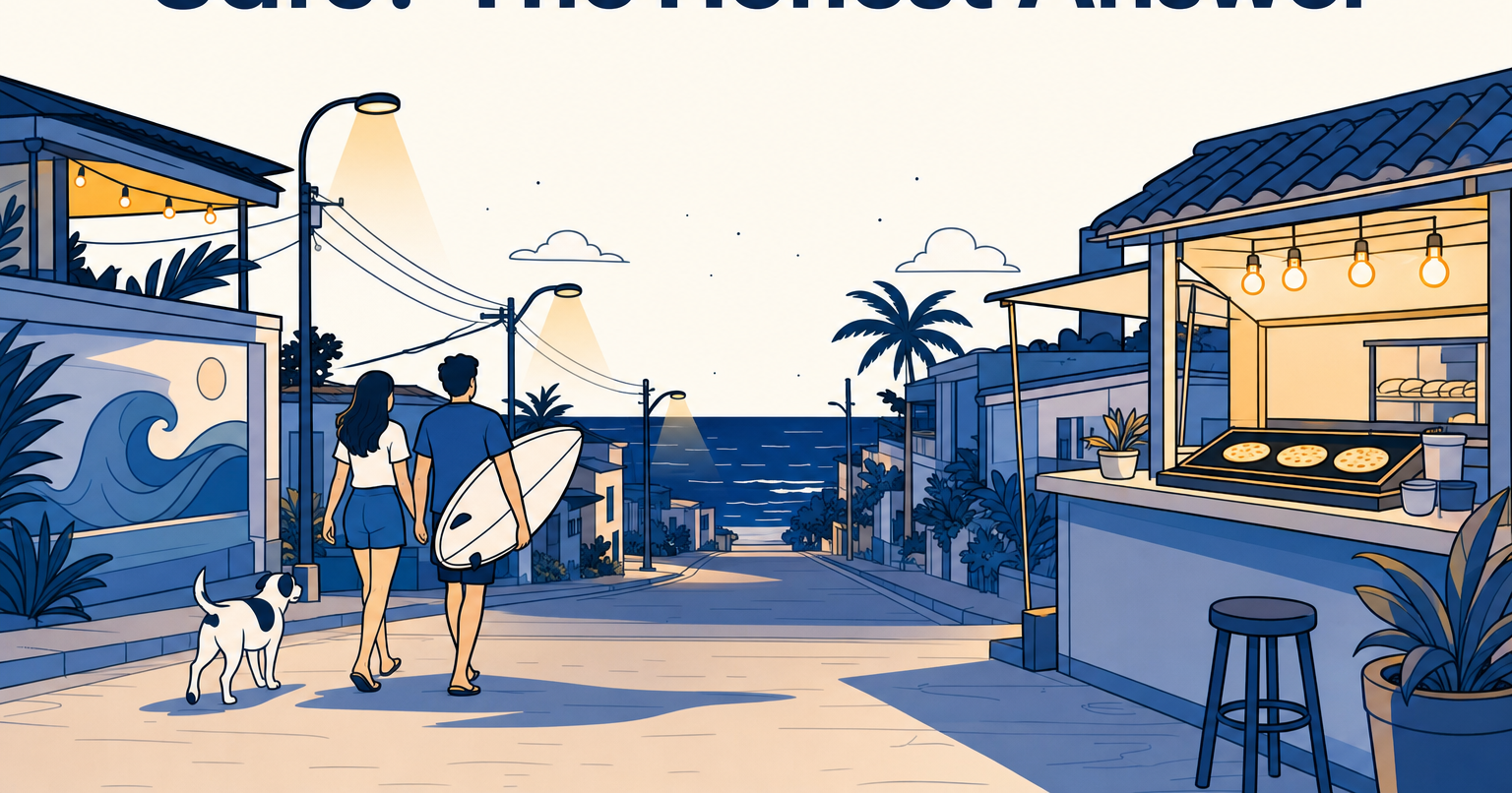
Is El Salvador safe for tourists now? An honest FAQ from people who live on the coast
Yes. El Salvador is safe for tourists in 2026, and the Surf City coast between La Libertad and El Zonte is one of the most policed and most visited stretches in the country. Couples, solo surfers and remote workers move through El Tunco and El Sunzal every week without anything happening to them. The realistic risks here are the ones you would plan for on any tropical coast: a bag left on the sand, an unmetered taxi that quotes you double, a rip current on a big swell, and a sunburn on day one.
That is the short answer. What follows are the questions guests actually message us before they book, answered the way we would answer them on the terrace with a coffee.
Has El Salvador really changed, or is that just marketing?
It changed, and you notice it in ordinary things rather than in headlines. Families eating pupusas outside at nine at night. Buses running after dark. Beach towns that used to empty at sundown now have people on the street at ten.
The country went from having one of the highest homicide rates in the world to one of the lowest in the Americas, and that shift came with an extended state of exception that is still in place. Practically, that means you will pass police and soldiers at checkpoints, at the entrance to El Tunco, and sometimes on the Litoral highway. They wave tourist vehicles through. Some visitors find the presence reassuring and some find it strange, but none of it is aimed at you.
What has not changed is basic street sense. A phone left face-up on a restaurant table is a phone left face-up on a restaurant table, whether you are in San Salvador or Lisbon. We go deeper into the national picture in our full safety guide.
Can I walk around El Tunco at night?
Yes. The main street is maybe four hundred meters long, lined with restaurants and hostels, lit, and busy until late, with a police post near the entrance off the highway. Couples walk it. Solo travelers walk it. We send guests down there for dinner constantly.
Two caveats worth taking seriously. The side lanes toward the river and the unlit stretch of sand past the rocks are a different environment after dark, and there is no reason for you to be on either at one in the morning. And El Tunco is a party town, which means the trouble that does happen there is overwhelmingly alcohol, not crime: someone loses a phone, someone swims drunk. If you want this coast without the 2am reggaeton, the villages a few minutes west are a different world, and we compare them honestly in El Tunco vs El Sunzal for couples and in quieter than El Tunco.
Are Uber and taxis safe here?
Uber is the answer for most trips. It works in San Salvador, at the airport, and along the coast highway, the fare is fixed before you tap, and the ride is tracked. Airport to El Sunzal is roughly 45 minutes and usually lands somewhere in the thirty to fifty dollar range depending on the hour. Everything is priced in US dollars, so there is no currency math and no exchange-counter scam to worry about.
Where it gets thin is late at night and on the small access roads down to the beach. Do not count on summoning a car at 1am from a dirt lane below the highway. Local taxis are perfectly fine but unmetered, so agree the price out loud before you open the door, and expect a coastal hop between El Sunzal and El Tunco to be a small handful of dollars, not twenty. If you are landing tired, a shuttle booked in advance is the calmest option, and we lay out every route in getting from San Salvador to El Sunzal without a rental car.
What about theft on the beach while I surf?
This is the single most common thing that actually happens to visitors here, and it is almost entirely self-inflicted. A session at Sunzal runs two hours and the lineup sits a long paddle from shore. You cannot see your bag from out there. Nobody can.
So do not leave one. Passport, laptop and spare cash stay locked at your accommodation. Walk down with one card, a little cash and a key, and nothing else. The restaurants right on the sand at Sunzal will keep an eye on a bag if you are actually eating there, and the surf schools will hold your things while you take a class, but the cleanest version is arriving with nothing worth taking.
Is El Salvador safe for solo women travelers?
Broadly yes, and this coast is the easiest part of the country for it. Solo women surf Sunzal every day of the week, and the local surf community is more protective than first-timers expect. You should still expect some street attention, mostly verbal, mostly in town rather than at the beach, and mostly ignorable.
The habits that work are unglamorous. Stay somewhere gated with someone on site rather than an isolated house down an empty lane. Take an Uber after dark instead of walking a road you have not seen in daylight. Tell someone which break you are paddling out at and roughly when you will be back. Small adults-only properties tend to feel safer than big hostels for a boring reason: everyone inside the gate is accounted for, and the host actually notices if you do not come back.
Worth saving in your phone: 911 is the emergency number nationally, and POLITUR, the tourist police, has a presence in the Surf City beach towns.
Is driving the coast road risky?
The Litoral highway is a genuinely good road, well surfaced and one of the prettier drives in Central America, and daytime driving between the airport, La Libertad and El Zonte is easy. The hazards are ordinary ones: motorcycles overtaking on blind curves, pedestrians in dark clothing, speed bumps that appear without warning at village entrances, and heavy afternoon rain from May through October.
Our rule has two parts. Do not drive the coast road at night if you can avoid it, and never leave a car parked with luggage visible through the glass. Honestly, most of our guests skip the rental altogether. Between the breaks, the restaurants and the beach, almost everything worth doing sits inside a fifteen-minute ride.
What is the risk people underestimate?
The ocean, every time. El Sunzal is a forgiving right-hand point and a fair place to learn, but Punta Roca is a serious wave over rock, and the rips pull hard when a south swell fills in. The injuries we hear about season after season involve reef, coral cuts and overconfidence, not crime.
Take a lesson on your first day even if you have surfed elsewhere. Ask a local which end of the beach to paddle out from, because the answer changes with the tide and the swell direction. If you want to time your trip to the water you can actually handle, the best time of year to visit for surfing breaks the seasons down.
Where should nervous first-timers stay?
Somewhere gated, quiet, and close enough that dinner does not require a car. That single combination erases most of the questions above before you ever have to ask them.
Our four apartments in Cerromar sit above El Sunzal with Pacific views and a private compound, and we live on this coast year-round, which means you can message us for the tide, a fair taxi price or a surf report and get an answer from someone standing in front of the same ocean. If that sounds like the version of El Salvador you came for, have a look at the stays.