
Is May to October a Bad Time to Visit El Salvador's Beaches? Why We Now Recommend Green Season
For most travelers, May to October is the better half of the year on El Salvador's Pacific coast — here is why the green season beats dry season for waves, beach solitude, and value, and what to expect from the rain.
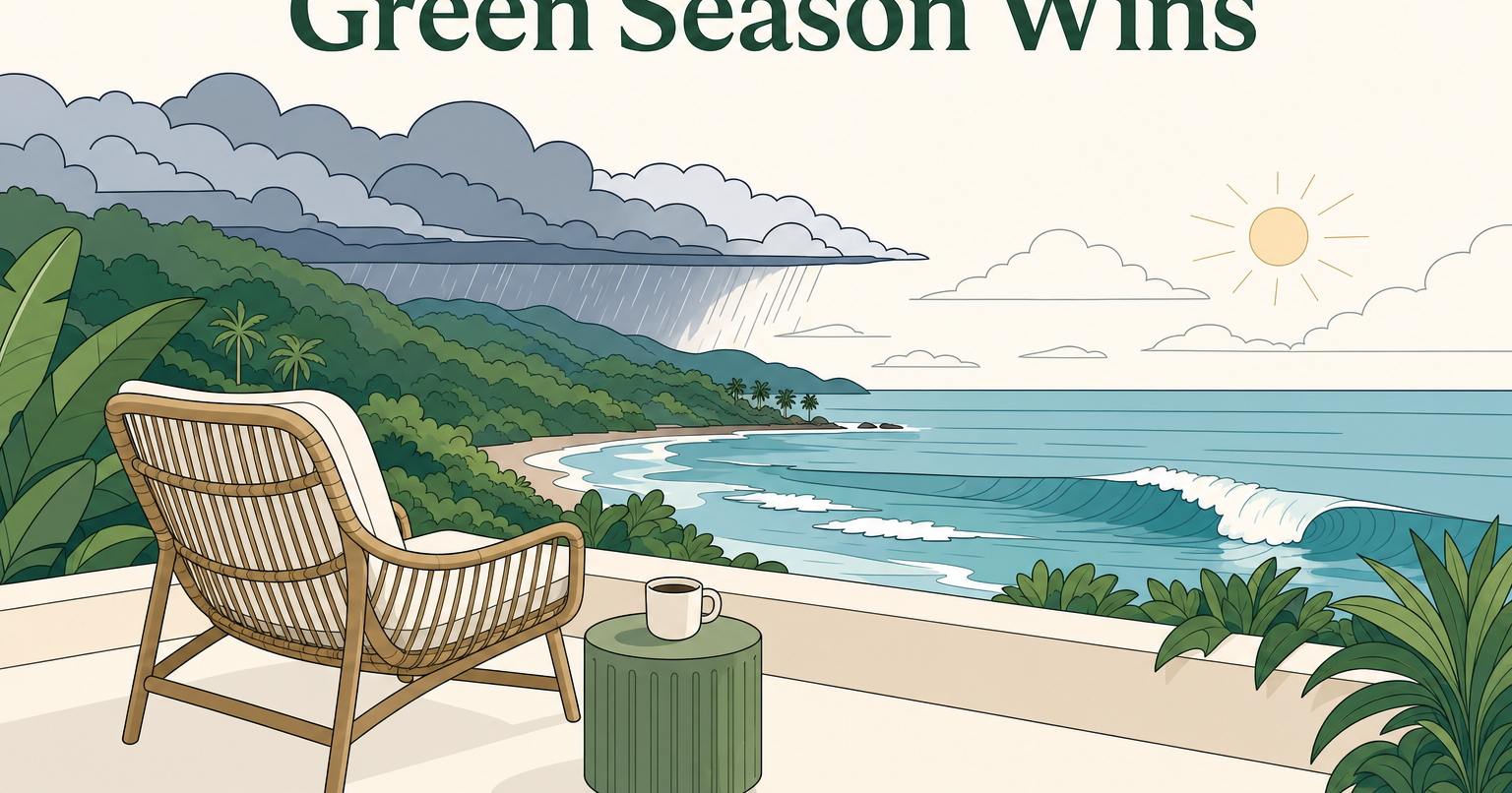
Is May to October a Bad Time to Visit El Salvador’s Beaches? Why We Now Recommend the Green Season
No. For most travelers, May to October is the better half of the year on El Salvador’s Pacific coast, and it is not a close call.
The rain here does not behave the way the phrase “rainy season” makes you picture it. It arrives as a short, loud afternoon storm and then leaves. The south swell that made El Sunzal and Punta Roca famous runs almost exclusively from April to October. The hills behind the coast turn a green you will not see in March. And on a Tuesday in September you can walk a long stretch of sand and pass nobody.
The label is the problem. Someone translated “temporada lluviosa” as “rainy season,” a travel planner abroad read that as “ruined trip,” and a decade of visitors booked the wrong months.
Where the dry-season advice came from
The standard line, repeated in guidebooks and by half the hotels on this coast: come between November and April, when it never rains.
That advice was written for a different trip. It made sense for someone circling the country by bus in the 1990s, when a wet afternoon could turn an unpaved stretch to soup and strand you somewhere unplanned. Dry season also happened to line up with North American and European winter holidays, so it became the default for a reason that has nothing to do with the coast: that was when people had vacation days.
Nobody went back and checked whether it was the better beach experience. It is not.
What actually changed
The Litoral highway through Surf City is now paved, fast and lit the whole way from the airport past El Sunzal. That single change is why a September downpour is now something you watch from a terrace with a beer instead of a problem you have to solve. If you are weighing the transfer, we broke down the options in our guide on getting from San Salvador to El Sunzal without a rental car.
The other change is who shows up. Most people booking El Sunzal now come for waves, quiet, and good food. They are not ticking off colonial churches. Optimize for those three things and the calendar flips.
The waves are the whole argument. The swell that lights up Sunzal’s long right-hand point is generated by winter storms in the Southern Hemisphere, thousands of kilometers away, which is why it lands here from roughly April to October and largely goes quiet after that. Dry season on this coast is frequently pretty and knee-high. Green season is when the point works properly, sometimes for ten or twelve days without a flat spell, and when Punta Roca turns into the wave people fly here for. Our wave guide to Surf City covers the individual breaks, and we go further on timing in the best time of year to visit El Salvador for surfing.
The landscape is a different country. By late February the hills behind Cerromar are brown and dusty, and the air hazes over from agricultural burning, which flattens the view toward the volcanoes. Two weeks after the first real May rain, the same slopes are dense green and the air is rinsed clean. Guests send us photos in June that look like they were taken somewhere else entirely.
The coast empties out. Semana Santa and the last week of December are when the whole country comes to the beach. El Tunco during Holy Week is a genuine festival and worth seeing once, but it is not rest. First week of September, same beach at 6am: you, two fishermen pulling in a net, and a pelican working the shorebreak.
And it costs less. Nightly rates along this coast drop noticeably outside the holiday peaks, and restaurants that need a reservation in December will seat you on the spot in August.
How the rain actually behaves
The daily rhythm is the part nobody explains, and it is the part that decides whether your trip works.
Mornings are almost always clear. Sunrise is around 5:40am year round, the wind is usually offshore or dead calm, and the water sits between 27 and 29 degrees Celsius, so you surf or swim in nothing but boardshorts. Clouds stack up over the volcanoes through midday. The storm lands somewhere between 3pm and 6pm, it is heavy and theatrical, and it is normally finished inside ninety minutes. Then the sky clears and the night is warm.
Plan the day around that and you lose almost nothing. Surf at first light, eat, nap, be under a roof by mid-afternoon, go out again at dusk.
- May. The switch flips. First swells, first rains, hills greening, still cheap and still quiet. One of the best-value months of the year.
- June. Consistent surf, dependable afternoon storms, bathwater temperatures.
- July and August. The canicula, a mid-season dry spell that runs one to three weeks with far less rain and steady swell. This is quietly the best window of the year, and the one we tell friends to book.
- September and October. The wettest months and the biggest surf. Serious swell. Also the highest chance of a genuinely rainy day rather than a rainy hour.
The trade-offs, honestly
Green season is not free of friction, and anyone who tells you otherwise has not spent an October here.
River-mouth beaches muddy up. After a heavy night of rain, the water at El Tunco and El Zonte can run brown and full of debris for a day or two, because the rivers dump straight into the lineup. El Sunzal, which is a rock and sand point rather than a river mouth, clears up faster. That difference matters more than most people realize when picking where to base yourself, and it is one of several reasons we point couples toward El Sunzal over El Tunco.
Mosquitoes are real from June onward. Bring repellent with picaridin or DEET, and sleep with the air conditioning or a fan running. It solves the problem almost entirely.
Humidity sits high. Cotton does not dry. Pack quick-dry everything, one light rain shell you will use twice, and reef-safe sunscreen, because the cloud cover does not stop the burn at this latitude.
And a few small places on the coast close midweek in the deepest part of September. Ask before you walk twenty minutes for dinner.
Who should still book November to April
Be honest about the trip you want.
Book dry season if you are learning to surf and want small, forgiving waves, if the point of the trip is volcano hikes and long-range views, or if school holidays give you no choice. Those are good reasons and the coast is still lovely in February.
Book May to October if you surf at all, if you want the beach mostly empty, or if the whole idea is to slow down and read something.
One practical note that decides how a green-season trip feels: stay somewhere with a covered outdoor space and an actual view of the water. The afternoon storm should be the evening’s entertainment, not the reason you are stuck indoors staring at your phone. That is largely why our four apartments in Cerromar are stacked across three levels facing the Pacific, all with sheltered terraces. Watching a squall move up the coast from Punta Roca toward Sunzal, with the point still working underneath it, is one of the better things you can do here.
If a green-season trip is taking shape, our direct booking page tends to have better availability in these months than people expect, and we are happy to tell you what the swell is likely to be doing the week you are looking at.